
Nanofiltration (NF) membranes occupy a unique position in the spectrum of pressure-driven membrane separation technologies, operating in the critical space between ultrafiltration (UF) and reverse osmosis (RO). As industries increasingly seek energy-efficient solutions for water treatment, nanofiltration membranes manufacturers in India like Adimem Technologies are revolutionizing the market with innovative membrane solutions that combine selective separation with lower operating pressures.
Understanding Nanofiltration Technology
Nano filtration membrane for water and wastewater treatment bridges the gap between UF and RO by offering molecular weight cutoffs (MWCO) typically between 200 and 1000 Daltons. Unlike UF membranes that primarily rely on size exclusion, or RO membranes that remove nearly all dissolved solids, NF membranes employ both charge-based separation and size exclusion mechanisms. This enables nanofiltration membranes for selective ion removal, effectively rejecting divalent ions such as sulfates, phosphates, calcium, and magnesium while allowing partial passage of monovalent salts like sodium and chloride.
Adimem Technologies’ FLUXA™ NF membrane series exemplifies this advanced technology. Their product line includes three distinct models designed for varying separation requirements: AMT-FLUXA™-NF-30 with 30-50% NaCl rejection, AMT-FLUXA™-NF-60 with 50-70% NaCl rejection, and AMT-FLUXA™-NF-90 with greater than 85% NaCl rejection. All three models achieve impressive 96-98% rejection of magnesium sulfate, demonstrating their effectiveness in divalent ion removal.
The Advantage: Made in India for the World
As one of India’s leading nanofiltration membrane suppliers in India, Adimem Technologies stands out as the first company in India with fully in-house membrane manufacturing capabilities. Based in Mumbai, Maharashtra, their proprietary core technology ensures complete control over every manufacturing step—from polymer casting to module assembly—delivering consistency, faster lead times, and application-specific performance. This domestic manufacturing capability positions Indian industries to access world-class membrane technology with localized support and competitive pricing.
Industrial Applications and Water Reuse
Industrial Applications and Water Reuse
Nanofiltration: Selective Separation
The versatility of industrial nanofiltration membranes for water reuse makes them invaluable across multiple sectors. In textile and dyeing industries, nanofiltration membrane for wastewater treatment enables effective color removal and dye recovery while allowing salt passage for chemical reuse. Adimem’s FLUXA™ NF-30 membrane is specifically designed for dye concentration and sugar separation applications where monovalent salt passage is desired.
In dairy and food processing, NF membranes excel at whey concentration, enzyme recovery, and juice clarification without complete demineralization. The pharmaceutical and biotech sectors leverage NF technology for API concentration and catalyst recovery, while chemical industries benefit from solvent recovery and intermediate purification capabilities.
Water softening applications particularly benefit from NF technology. By selectively removing hardness-causing calcium and magnesium ions while retaining some dissolved salts, NF systems reduce chemical dosing requirements for boiler feedwater and cooling tower operations compared to complete demineralization through RO.
Technical and Economic Benefits
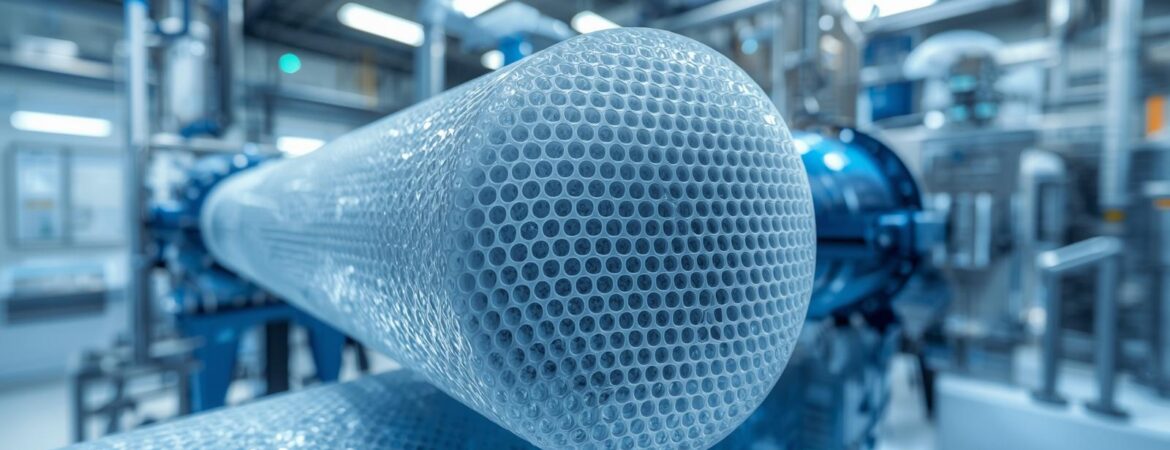
Adimem’s FLUXA™ NF membranes operate at significantly lower pressures than RO systems, translating to reduced energy consumption and operational costs. Available in standard industrial sizes (8040 with 37.2 m² membrane area and 4040 with 7.5 m² membrane area), these spiral wound membranes feature FRP outer wrap construction and broad pH tolerance for effective cleaning-in-place (CIP) operations.
The partial salt passage characteristic of NF membranes reduces osmotic pressure limitations, enabling higher recovery rates and minimizing concentrate disposal challenges. This selective permeability also makes NF ideal for applications requiring partial desalination rather than complete salt removal.
Conclusion
As India’s water treatment industry continues evolving, the role of advanced nanofiltration membrane suppliers in India becomes increasingly critical. Adimem Technologies’ commitment to indigenous manufacturing and innovation provides industries with reliable, cost-effective solutions for achieving their water treatment objectives. Whether for zero liquid discharge systems, water recycling, or specialized industrial processes, NF technology offers the perfect balance between separation efficiency and operational economy, making it an indispensable tool for sustainable industrial water management.
Progressive textile manufacturers are embracing Zero Liquid Discharge (ZLD) concepts, where membrane systems form the core treatment train. Adimem Technologies provides comprehensive ZLD solutions combining UF, NF, and RO technologies with evaporation and crystallization systems, eliminating wastewater discharge entirely while maximizing resource recovery.