

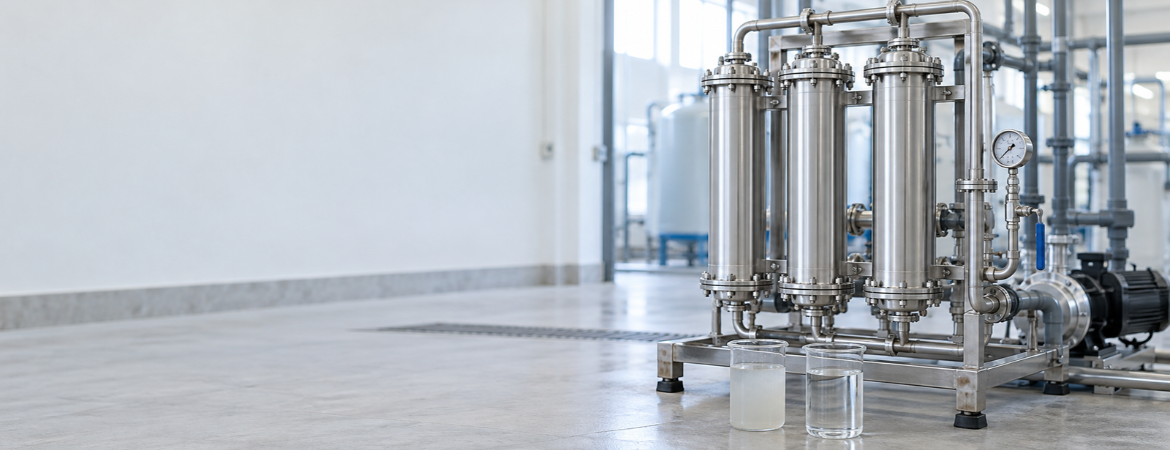
Microfiltration Systems for Suspended Solids Removal: How They Work
Cloudy feed water, fine particulates and bacteria can foul downstream equipment and spoil product quality. A microfiltration system for suspended solids removal tackles these problems at the front of the process, using a membrane as a precise physical barrier. This guide explains how microfiltration works, what a typical system includes and where ultrafiltration takes over. Product examples are drawn from Adimem Technology, an Indian manufacturer of MF, UF, NF, RO and MBR membranes.
How Microfiltration Works
Microfiltration is a pressure-driven process. Feed is pushed against a porous membrane, and water, dissolved salts and small molecules pass through as permeate. Suspended solids, bacteria and larger particles are held back as retentate.
Pore sizes typically sit around 0.1 µm and above. Adimem’s FLUXA MF spiral wound PVDF membranes, for instance, are offered in 0.1, 0.2 and 0.45 µm options.
Systems run in one of two modes:
- • Dead-end filtration: All the feed passes through the membrane. It is simple and suits low-solids streams, but the surface loads up and needs regular backwashing.
- • Crossflow filtration: Feed sweeps along the membrane surface, which limits build-up and suits higher-solids or more variable streams.
Key Components of a Microfiltration System
A well-designed system is more than the membrane itself. Look for these elements:
- • Pre-screening or strainer: protects the membrane from large debris
- • Feed and circulation pumps: maintain the right pressure and flow
- • Membrane modules: spiral wound, hollow fibre or tubular, chosen to suit the feed
- • Backwash and cleaning-in-place (CIP) provisions: restore flux between runs
- • Instrumentation and controls: monitor pressure, flow and turbidity
Where Microfiltration Is Used
Microfiltration is valued wherever clarity and particle removal matter. Adimem’s industry pages list uses such as sterile filtration and sugar syrup polishing in beverages, and juice clarification in food processing. It is equally useful as pre-treatment in wastewater reuse, protecting UF, NF and RO membranes further downstream from fouling by suspended solids.
From Suspended Solids to Proteins: Where Ultrafiltration Comes In
Microfiltration removes particles, cells and debris. Proteins, however, are dissolved macromolecules and pass straight through an MF membrane. That is where an ultrafiltration membrane for protein separation comes in.
UF membranes have much finer pores, usually rated by molecular weight cut-off. They retain proteins while letting water, salts and small molecules through. A common sequence runs as follows:
- 1. MF first: clarify the feed by removing cells, fat and suspended matter.
- 2. UF second: concentrate or purify the protein-rich stream.
Adimem Technology’s range reflects this split. It includes FYBRIN hollow fibre UF membranes, TUBIONIQ tubular UF membranes for high-viscosity applications, and lab-grade PVDF, PES and PS flat sheets for biotech and analytical work. Its industry pages also cite whey concentration and enzyme recovery as typical UF uses.
How to Choose the Right System
Before you specify equipment, work through these questions:
- • What is the particle size and solids load? This sets the pore size and whether dead-end or crossflow suits you better.
- • How viscous is the feed? Thick streams may need tubular modules rather than spiral wound.
- • Is the membrane material compatible? Check chemical resistance against your cleaning agents and process fluids.
- • What flux and recovery do you need? Undersized membrane area leads to rapid fouling.
- • How will cleaning be handled? Plan backwash and CIP from the start, not as an afterthought.
Whenever possible, run a pilot trial with your actual feed. Real streams behave differently from lab samples, and a short trial often saves months of troubleshooting.
Final Thoughts
Microfiltration is the workhorse for removing suspended solids, and ultrafiltration takes over when the target is a dissolved protein. Define your feed, particle size and goal, then test before you scale. The engineers at Adimem Technology can help with module selection and system sizing.