

MBR Membrane Manufacturers in India: A Buyer's Checklist
Choosing an MBR membrane is a long-term decision. The module sits at the heart of your treatment plant, and a poor match shows up as fouling, higher energy bills and unplanned downtime. This checklist helps plant owners and consultants compare MBR membranes manufacturers in India on the points that matter. At Adimem Technologies, we make our MBR membranes ourselves, so under each point we also explain how we do it.
1. Confirm They Actually Manufacture
Many suppliers import and rebrand. Ask where casting, rolling, potting and testing take place, and put this question first, because it shapes everything that follows.
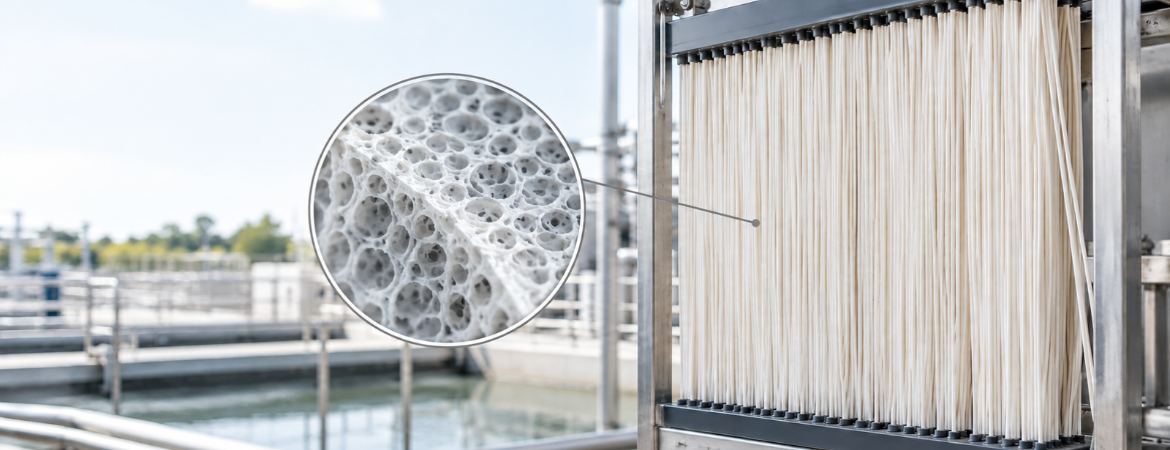
How we do it: We are the first in India with fully in-house membrane manufacturing. Casting, rolling, potting and testing all happen in our own facility, which supports consistency and shorter lead times. Our membranes are made using our proprietary Reverse Phase Transition™ process, developed by our own R&D team. It is a hybrid of NIPS and TIPS, designed for high surface porosity, a uniform pore structure and durable, low-fouling membranes.
2. Match the Configuration to Your Plant
- • Hollow fibre: offers high surface area, a compact design and high flux, which suits large municipal and industrial systems.
- • Flat sheet: offers greater mechanical strength, stable performance under variable loads and easier maintenance. It suits decentralised and modular systems, and uses less aeration energy than hollow fibre.
3. Ask About Pore Size Options
Pore size should follow the wastewater profile. A supplier offering only one option may be forcing your plant to fit its product.
How we do it: We offer 0.1 µm modules for municipal STPs and industrial ETPs, and 0.03 µm modules for tertiary filtration, greywater reuse and colour removal, in both hollow fibre and flat sheet.
4. Demand Performance Figures
Request flux ranges, fouling behaviour and treated-water quality in writing, and ask what conditions those numbers assume.
How we do it: Our ARISE™ range delivers a flux of 15–35 LMH, with treated water at BOD below 5 ppm and turbidity below 1 NTU. We can support those figures with pilot testing and performance guarantees for your effluent.
5. Look at the Wider Product Range
Reuse projects rarely stop at the bioreactor. You may need polishing or desalination downstream, so check whether the supplier also covers the following:
- • Microfiltration: useful when comparing microfiltration membrane suppliers in India for pre-treatment or clarification.
- • RO: relevant when shortlisting RO membrane manufacturers in India for high-purity reuse.
- • Broader industrial membranes: industrial filtration membranes manufacturers in India vary widely in breadth, and a single source simplifies compatibility, servicing and accountability.
How we do it: Our portfolio spans FLUXA™ spiral wound MF, UF, NF and RO membranes, FYBRIN™ hollow fibre UF, ARISE™ MBR and TUBIONIQ™ tubular UF. All are made in-house, so you can build the whole treatment train with one manufacturer.
6. Check Engineering Support and Pilot Testing
Membranes perform only as well as the system around them. Look for design support, module selection help, system sizing and pilot testing before you commit. If space or time is tight, ask about containerised options.
How we do it: Our engineers help with module selection, process design and full system sizing, and our ARISE™ range is backed by pilot testing and lifecycle service. Our AriseBox™ is a factory-tested, containerised MBR unit from 10 KLD to 200 KLD, with screening, aeration, membrane tank, blower, pumps and PLC/HMI controls included. It needs minimal civil work, which suits residential complexes, industrial units and labour camps.
7. Compare Lifecycle Cost, Not Just Price
The cheapest module can become the most expensive once you add aeration energy, cleaning chemicals, labour and early replacement. Ask for expected membrane life, cleaning frequency and service terms, and put them next to the purchase price.
How we do it: Our RPT process is designed for low fouling and easy cleaning, which helps cut energy and maintenance costs over the life of the plant. We also provide lifecycle service after commissioning.
How We Do It and What Makes Adimem Different
- • We manufacture; we don’t rebrand. The membrane in your plant is made under our own quality control.
- • Made in India, built for the world. We combine domestic manufacturing with global quality standards.
- • We own the process. Our Reverse Phase Transition™ technology is our own, so we can tune performance to your application.
- • We cover the full journey. From MF pre-treatment to RO polishing, and from a single membrane to a finished plant, you deal with one team.
- • We design around your effluent. We start with your flow, contaminants and discharge or reuse targets, then recommend the format, pore size and configuration.
- • We build for sustainability. Our membranes are engineered to conserve resources and meet environmental compliance.
Quick Checklist Before You Decide
- • Is manufacturing done in-house?
- • Are both hollow fibre and flat sheet options available?
- • Do pore size options match your wastewater?
- • Are performance figures documented and backed by guarantees?
- • Does the range extend to MF, UF, NF and RO?
- • Is pilot testing and lifecycle service offered?
These are the questions we expect buyers to ask us, and we are happy to answer every one.
Final Word
Shortlist two or three suppliers and send each the same effluent data, then compare their answers side by side. The strongest suppliers tend to ask you questions before they quote. If you would like an engineer’s view on module choice, process design or system sizing, speak to the Adimem Technologies team.